Sunday, May 13, 2018

The first time our dog bit our son...

...was the last time.  That's the only reasonable way that sentence should end. Right?

Bad dog

I have a short story for you.  A friend told me about the time his little baby girl was bitten in the face by his ex-partner's dog.  He demanded the dog be put down or else.  His ex-partner loved that dog.  She and her mother tried to convince him that the dog was just adjusting and had always been a good dog and why not give him a second chance?  My friend got in his car, took the dog from his ex-partner's house, drove him to the vet, and had him put down.  I heard that story in disbelief of the ex-partner's attitude.  What kind of people would keep a dog that bit a child on her face?

Over the years, I've marveled at the devotion and love friends and family members show towards their dogs.  They let them share their furniture, miss vacations to care for them, spend thousands of dollars on vet bills, usher them in and out of the house a thousand times during a single meal, worry about them as they age, and then let them go when it's time. 

Not us, I've always insisted.  And for damn sure, if I ever - I mean ever had a pet that bit my kid, that pet would be history before my kid had stopped crying.  Except something happens to you when A) you actually get a dog, and B) you live where we've been living this year. 

First, A:  I grew up with a dog, a German Shepherd, in fact.  She was very sweet and gentle, and she lived a good, long life.  Her name was Cleo.  When we arrived in Mekele, an American family was desperate to get rid of an 8 month old German Shepherd they'd been saddled with when his owners had to return to the US unexpectedly.  Enter Marta Woodward, whose boys had never had a dog, and who'd always sworn that if she ever lived in Africa again, she'd get a dog.  We took the dog, changed his name from Howard (come on) to Teddy, and proceeded to experience what every dog owner I've ever known experiences; the almost total loss of previously held boundaries.  No, Teddy does not share our furniture, and no, we don't get up a million and one times to let him in and out of the house.  But that dog became a sort of salvation for our family.

To imagine how our boys' lives changed when we came to Mekele, you have to remember that we yanked them from every single routine that had structured their lives for years:  School, soccer, friends, youth group, the NFL, Chipotle - all gone with the decision their parents made to bring them not just to Ethiopia, but to a relative frontier town in Ethiopia.  There is no one their age in this town that even remotely shares their day-to-day background.  Sure, they play soccer sometimes with the very kind neighborhood boys, and they have a good time playing with the kids at ORE, but otherwise, their friendships have been distilled to include just them.  The three of them.  And their dog.  Our dog. 

Our dog, who loves to play fetch so much that if you don't bring him his toy, he'll find a papaya branch and bring that to you, or his blanket, or a stone; anything that you'll toss for him so he can run and bring it back to you.  Our dog who greets us so heartily every single time we walk back in our gate that we stand there and laugh at him spinning in circles as if to take us all in at the same time.  Our dog who made the boys feel normal after hearing the constant calls of "Ferenji, Ferenji" - which we're always told is never meant to be an insult, but which at best sounds to me like "Different!  Different!"  These cries follow the boys still; every single day.  For these boys, Teddy was a bright spot in their day and hearing their laughter as they played with him made us feel less guilty about uprooting them.

So that's A.  The dog starts to mean something to you that's hard to describe; a bonding agent between you and your kids, a presence in your lives that is relentlessly playful and silly - even when you feel different, lonely, and homesick.

As for B (where we live), Teddy is an amazing guard dog.  Plain and simple.  He's an exceptionally nervous dog, barks at anything that moves outside the gate, knows strangers who might be out there from people that regularly visit, and is so tightly wired that he barks at beetles and pieces of paper floating by on a breeze.  These are great traits for a guard dog.  And although Mekele is said to be safe, we know people who've had their homes burglarized, including one family whose home was invaded as they slept.  We live on the edge of a neighborhood that overlooks nothing but scrubby trees and the hyenas that come out at night.  We are fully exposed to anyone and anything, and we are - as we're constantly reminded - mostly Ferenjis; we're known, and are therefore easy targets.  If it weren't for Teddy, I wouldn't be able to sleep at night. 

So, the first time he bit Micah, we were horrified.  Mark and I took him to a hospital here and were blown away both by the insanity of the place, and by the ability of the staff to navigate it calmly and cleanly.  Micah had his wounds (two puncture marks on his forearm and a cut on his shoulder) cleaned in the same room as someone who seemed to be having a heart attack, a woman with acute appendicitis, and a man in agony having his ingrown toe nails removed.  There was a lot of moaning, bewildered looking family members, old people who were sick and had no one with them.  Since Teddy had been vaccinated, the doctor gave Micah a tetanus booster after cleaning him up, and sent us on our way so she could figure out what to do with the chaos going on around her.  We left that hospital and thought, "Thank God we never have to go through that again."

Teddy would have to die, that was clear.  I didn't know how, but he would have to go.  Except for A.  A meant that Micah was terrified of him, and yet was even more terrified that we would put him down.  Eli and Daniel were silent and brooding about it all.  It was five months ago.  We still had seven months to go in Mekele.  I hesitated.  What would it be like to not hear the boys laughing outside anymore?  And what about B - what about security? 

We went over and over what happened, and did what I could not ever imagine us doing.  We justified the bite.  It happened like this.  We'd slaughtered a sheep and had given Teddy the head.  Teddy had been hunkered down with it for a while, with Micah chilling nearby.  Micah came over to pet him and Teddy lunged.  Protective.  That's what dogs are, especially German Shepherds.  Of course, we thought.  That was bound to happen.  Don't get between a dog and his bone, he's young, he'll learn, Micah needs to appreciate dog mentality...you get the idea.  We justified it, and we did exactly what my friend's ex-partner wanted to do with her dog.  We gave Teddy a second chance. Micah adjusted quickly and the two became fast friends again.


So...the second time Teddy bit Micah....well.  That was three days ago.  We'd all recovered from the first bite and Teddy had again become the apple of our eye.  Laughter filled our compound, and we felt safe all the time.  So when our landlord came to visit three days ago and Mark and I were outside the gate with him, Teddy naturally wanted to know what was going on.  He ran to the gate and Micah - who's horrified that he'll get out and bite someone else (because, ahem, that did happen once when the gate was left ajar and he saw a kid running from him, then nipped his calf before Micah caught him and dragged him back inside the gate) grabbed him from behind.  Teddy - being single-minded and nervous by nature - jumped up and bit Micah.  This time, on his face.  His jaw, to be precise.  He also left tooth marks on his belly and neck. 

We ran inside and Mark disciplined the dog with - shall we say - great passion. I took one look at the flap of skin hanging off my son's jaw, and commenced to bawling.  Micah kept asking, "Is it bad?  Is it bad?" and I just kept crying.  Yes, it was bad.  But I was crying because I didn't know what to do.  Didn't know where to take him, didn't know who would repair that awful cut, didn't know what to do with Teddy because I didn't have a gun and couldn't take him out to the scrubby trees and put him down humanely with a single shot.  I was overwhelmed and helpless, as I've been many times this year.  But this time, my kid's cheek was open and a flap of skin was hanging down his jaw like a shirt collar.  His dad and I'd made that possible. 

Sarah and Bill, friends who live here, came and took us to the major hospital in town. It was a bigger and more chaotic version of the first hospital we'd taken Micah to.  In a sickening replay of earlier events, we filled out a form, got him examined, received a prescription, were sent to the pharmacy to buy everything needed to treat him, and handed it to the doc.  Yes, you literally have to buy saline solution, syringes, gauze, gloves, tetanus vaccines, and anything else deemed necessary for your own treatment before you can be treated.  All around us were villagers who'd brought their desperately sick little babies, people sitting on mattresses in the hall, heads in their hands.  The sounds of crying babies, the looks of their exhausted mothers, the young doctors handling it all with calm and grace - it made me look at Micah's wound and feel grateful that it wasn't more serious. 
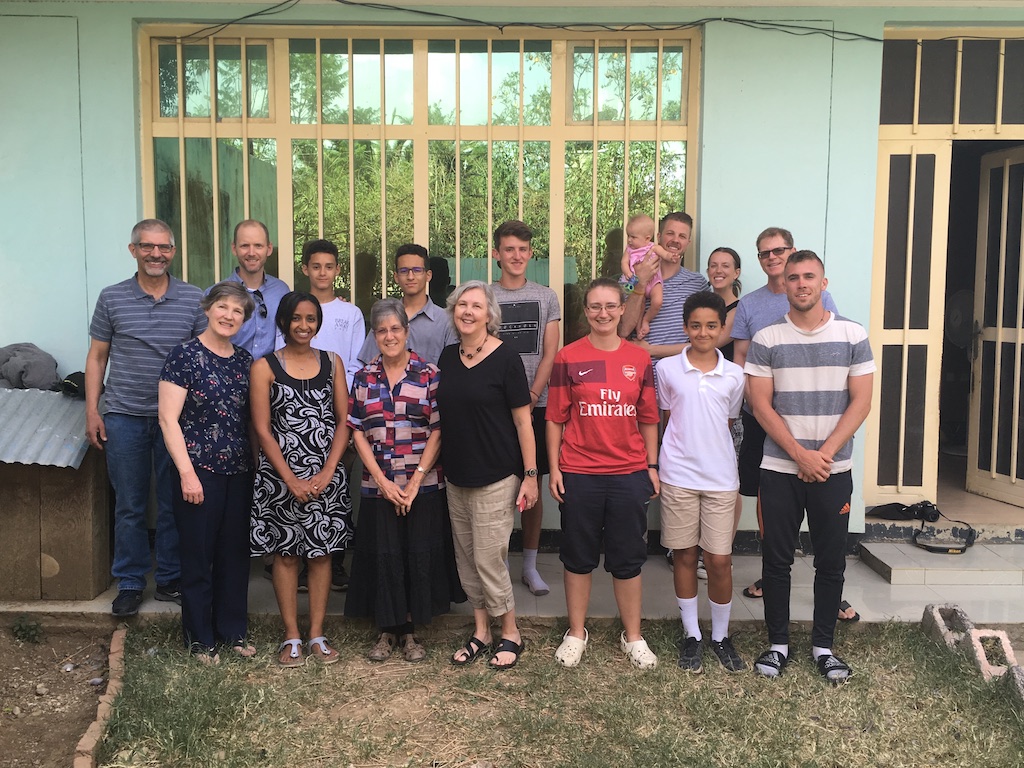
Our regular Sunday group, minus the Patterson family (who'd agreed to temporarily keep Teddy
before we came and took him off their hands).  Many of these
folks helped us out on bite night, and have helped out many times before.
front row: Elizabeth, Marta, Carol, Kristi, Sarah, Micah, Jake.
back row: Bill, Mark, Eli, Daniel, Thomas (visiting from UK), baby Rowena, Greg, EJ, John.

But.  I knew it would scar.  I knew it, and there was nothing I could do about it.  Bill called a doctor friend in Addis and he talked us through what usually happens with dog bites, stressed the importance of cleaning it thoroughly, and said often they don't close the wound immediately.  He was extremely helpful, but ultimately, he was in Addis, and we were in this crazy ER with docs who'd pulled the short straw because it was a holiday. 

At some point, an intern told me that Micah had to be seen by a maxillofacial specialist for the stitches.  She pointed to a central area of the ER, and I assumed that was where the specialist would see us.  But it was an ER doc who tended to us, and on his instructions, I held the bag of saline for him and wet some gauze with it so he could clean the wound.  He kept reminding me ("Don't touch me, don't touch me!") not to let the dripping needle of saline touch any part of him.  Such was the sterile technique of the ER. No face masks on anyone, all kinds of stains on the floor, lots of people standing around looking at this Ferenji kid with his skin hanging down his jaw.  Craziness. 

So when the same ER doc pushed some lidocaine into Micah's cheek and hurriedly pulled out a curved little needle and some absorbable thread,  I saw what was coming.  I gently leaned towards him and asked "Are you the maxillofacial specialist?" And he was already pulling Micah's cheek together with the curved needle.  He calmly said, "No.  I am the ER doctor on call."  So then I stood back and thought, "Okay.  This is what you get.  You came here.  You got the dog.  You kept the dog. So this is what you get."  And we just watched him do the best job he could, pulling Micah back together again.

Carol, a nurse friend, has told us that when we're back in the States, a plastic surgeon can fix the scar.  My friend Zeb in Addis talked to a couple of docs who saw the pictures I sent them of the stitch job and said basically "small wound, leave it be."

And it is a smallish wound.  But it's ugly.  Not because it's nasty looking, but because I see it and am reminded of the risks we've exposed our kids to this year.  I jokingly have told Mark again and again, "It's the year of living dangerously." Maybe, but looking at Micah's bruised face reminds me that the greatest price has been paid by our kids.

The boys and a younger Teddy

But life goes on in weird and surreal ways.  The very next morning, we performed in a martial arts show, of all things.  Readers of this blog may recall that we've hired a personal trainer. He is a Tae Kwon Do black belt whose dedication to the Ariana Grande song "Break Free" knows absolutely no bounds; it plays on a loop for an hour straight every single workout session.  He scheduled a performance for the kids of ORE featuring our family and Sandra (Swiss volunteer).  He asked us to wear red t-shirts.  When we got there, he handed us a roll of gauze and told us to make headbands. 

So there we were, Micah's face looking like he fought a lion, all of us sleep-deprived and anxious, standing in a straight line in front of the kids and staff of ORE with gauze tied around our heads, and Ariana declaring over the speaker, "This is the part where I say I don't wanna..."   To make matters worse, our trainer threw in an unexpected move and told us to run and leap into two somersaults in a row, each ending in classic martial arts fight stance and the battle cry "KYAH!"  If you don't think that's a big deal, go out and do a somersault right now, and then imagine you're forty-six and haven't done one in thirty-six years.  Needless to say, my "KYAH!" was more like "KY-OW!"  But the kids all clapped. 

Sadly, I don't have any pics of our show, but a soccer game was played
immediately after.  ORE believes the best way
to bid volunteers farewell is to form a staff/student team (yellow)
and decimate a team of volunteers (red). This was Sandra's last day after
a five month stint at ORE.  Our trainer, Teame, crouches between Daniel and Sandra
in the front row, hand on heart.

We did our show and it made Micah happy to be there and active.  And it made me think of the bravery of our boys as they went along with the program, kicking and punching in beginner style for an audience of kids they were certain would make fun of them afterwards.  Teame, a born-again Christian, was careful to ask Micah, "Are you okay, Brother Micah?"  Brother Micah was okay.

So what do we do with Teddy?  Here's how I imagine conversations going in the States: 
Me:  I think we have to keep Teddy.  We're leaving in less than two months.  We need the security.  Even Micah wants him to stay.
Friend in America:  I'm sorry, but I'm looking up Mekele Child Protective Services.

Here's how it goes here:
Me: We're going to keep Teddy until we leave, then we'll give him to an Ethiopian family who still wants him.
Americans in Ethiopia: Good.  So glad you don't have to deal with finding a way to put him down.  Micah will be fine, keep your eye on him.

Or:

Me: We have to kill that dog.
Ethiopian friends: Why????  I'll take him!

So...the dog stays.  I know, I know.  But if I told you how friends here have had to put their pets down (think strychnine for a cancer ridden dog, or holding a kitten with a broken neck under water), then you would understand that putting this guy through that when he was the one who brought laughter back to my boys would be really, really tough.  And you would look at Micah's nicely healing scar, the big valley outside where anyone can hide at night, and the dwindling days on our "year away" calendar, and you might make the same decision.  Anyway, our friend Jake has offered to take Teddy for the remainder of the time and swap him with his old dog, Trisca.  Just so that Micah can feel safe, and the rest of us can too.  Isn't that something?

The third time Teddy bit Micah....just kidding.  Too soon?

ps:

Hazal's completely boring now and her goody-goody sister Kansu is now the crazy one, having lost her unborn baby in a car accident and then - being from a filthy rich family - allowed her mother to buy a baby off a poor family so she wouldn't feel so bad.

More importantly, Mark and I - with the help of the incredible ORE staff - took the kids who'd performed well in their schools this year on a field trip to Wukro museum an hour away, and to an ancient rock church that dates back 1664 years.  Daniel came along, and a good time was had by all.

Me'areg, tour guide, explains some of the exhibits at Wukro Museum - a
joint venture of the Tigray Regional Government and The German Society
We carried lunch with us.  A huge cauldron of injera fir fir, and eighty egg sandwiches
prepared by ORE staff early in the morning.
These girls were chosen as part of the lunch committee (left to right, Rishan,
Girmanesh, Elam, Zenebu, and chaperone Susanne)
The museum staff stood by in awe as our students - without being asked -
found brooms, swept up their lunch mess, and washed up all the dishes.
Outside the ancient Wukro Chirkos

Wednesday, April 25, 2018

So you think you know Ethiopian food?


I know two and a half months sounds like a long time, but our experience once we got settled in Mekele is that time flies when you’re having fun.  And despite the sad and very abrupt demise this very day of the Devotion/Fight Club after many pseudo-successful runs of the Old Testament’s greatest hits, we are having fun.  Other sad news served to make the day a heavy one.  So it seems the thing to do is to consider the good things in life and celebrate them while we can.

Platters awaiting raw meat at a restaurant that
specializes in meat.  We have not braved raw meat here, but
it's a national delicacy.

I’ll fill you in on why our intrepid theatrical company tanked, as well as the other heavy news later.  Right now - and before our time in Mekele is up and I forget to do it - I really want to write about something I always find uplifting; the surprising and unique foods of Ethiopia.  If you live in the DC area - or if you are at all a foodie - you will have at least tasted Ethiopian food.  But in all likelihood, you will have been exposed to a fraction of what might be considered typical of Ethiopian food.  I certainly was, and I grew up eating it.  This blog is dedicated to the few months we have left to enjoy these tasty items, because most of them are difficult, if not impossible to find outside this country.

I have quite a few friends who aren’t fans of Ethiopian food.  Haters, I hope you read this and find enlightenment.


For orientation purposes, I’ll start with what a plate of typical Ethiopian food looks like. On the left, we have the star of the show; Injera, which is a flat, soft and bitter bread made from a grain called Tef. You use the injera both as a nutritious gluten-free food item, but also as a utensil to scoop up various sauces, such as the sauces shown here; siga wat (spicy meat stew), shiro (chickpea paste), and ye atikilt alicha (veggie stew).  Eating is done strictly with the right hand.  Traditionally, you would eat from the same large plate.  At home we always eat individual portions, like this. These are just a few of the many, many sauces typical of Ethiopian food. 


Moving on to slightly more exotic items, above we have shekla tibs; tender pieces of meat cooked at high heat on a clay stove, typically with onions, green chili peppers, and maybe tomatoes.  In the States, tibs is a favorite dish - tasty, unthreatening, universally pleasing.  Unfortunately, in the States, tibs rarely comes cooked on the miniature clay stove pictured above (shekla).  It’s sort of like a fajita situation, sizzling meat that’s crispy on the outside, tender on the inside.  It is typically eaten with the spicy red chili-based sauce in the picture (awaze) or with mitmita, a dangerously hot powder that you have to eat strategically so that you don’t accidentally inhale it.  (The trick is to dip the injera in the mitmita first, and then get a piece of meat so that when you put it in your mouth, the meat - not the mitmita is facing the back of your throat.  Sorry for the detail, I simply want you to benefit from my own disastrous experiences.) 

Behind the shekla tibs in a little covered pot is a dish called tegamino shiro.  Tegamino, in Italian, means fried.  But really, this is a shiro (chick pea sauce), that’s hard to get anywhere else because it’s cooked in a clay pot, rather than in a metal pan.  The clay pot imparts this delicious, deep, buttery flavor that’s impossible to beat.  Add to that the fact that Tigrayans are known for their shiro powder - the base of the sauce - and I can tell you we’ve never eaten shiro like this anywhere else.  Shiro - you can get in any Ethiopian/Eritrean restaurant in the States.  Tegamino shiro?  I’m not so sure.


Our friend Messi serves Tilho in her home

Moving on to even more exotic items, tilho is a dish that originated in a town called Adigrat, right here in Tigray.  Perhaps you recognize, that flat, pancakey thing covering the bottom of the plate. It’s injera, spread flat this time instead of rolled up.  In the center of the plate is a clay pot filled with a very spicy, very oily wat made with lots of onions, tomatoes, and dried beef.  Topping that wat is a unique, quite bitter yoghurt sauce garnished with herbs.  The little dumplings surrounding the clay pot are made of barley flour and water.  You take a tiny fork, pick up a dumpling, dip it into the wat, then the yoghurt, and enjoy a mouthful of the richest food you’ll ever taste. I have never been able to put away more than three bites. I'm willing to bet you can't really find this in the States.  You can’t really even find it outside of select parts of Tigray province, Ethiopia.


I’m moving on to breakfast dishes.  The dish above is not particularly exotic, in fact it’s really just cracked wheat.  But when you season the cracked wheat with salt and clarified butter, then what you’ve made is kinche, a favorite breakfast dish of mine since childhood.  Some of the people in my household who don’t have Ethiopian blood like to destroy the dish by drizzling honey or maple syrup on it, claiming that too many spicy/salty breakfast dishes go against the very nature of breakfast.  To each his own.  This is a very homey dish and I haven’t seen it on any menus Stateside.


In Ethiopia/Eritrea, when you scramble eggs, you finely dice and fry onions, green chili peppers, and sometimes tomatoes.  Then you add the eggs.  A very typical bread from this region is a bread that is only good the day it’s bought - actually, the morning it’s baked.  It is neither crunchy nor chewy, easily torn apart, and hasn’t got much flavor, but is very sturdy and easy to eat with a variety of breakfast foods.  It costs basically nothing and is sold in at least three little kiosks very close to us.  Just before we left the States, we finally found a delicious rendition of this common breakfast minus the bread at Meleket Restaurant in Silver Spring (owner Abe Bayu is a friend).


American Ethiopians/Eritreans will quickly recognize this dish - called fitfit, or injera firfir - because it’s a great way to get rid of old injera and whatever wat you have handy, and they probably ate it a lot growing up.  Usually, you would use left over wat (spicy stew), heat it up in a saucepan and break injera up into it.  Here, often the sauce is not left-over, but made fresh with berbere (red chili powder and other spices), oil, and very finely diced tomatoes and onions - a sauce known as silsi).  Although this is a super-homey dish, you can usually get it at most Ethiopian restaurants.  In our home, we always eat/ate it for breakfast.


Kitcha firfir (or chechebsa) is hands down the favorite household breakfast, and also not that common in US restaurants.  It is basically a thick tortilla broken up, then fried with clarified butter and berbere.  There is even a version I’d never met before - which is made with honey (right side of picture).  The spicy version is best eaten with yoghurt.  If you want to eat a really good version and you live in the DC metro area, go down to NoVA and eat the version with meat at Cafe Aurora (Dahab, the owner is also a friend).  You can also get it at Meleket Restaurant in Silver Spring.  I really haven’t seen it anywhere else.


Ful (commonly spelled fool) is not traditionally an Ethiopian/Eritrean dish, but an Egyptian one.  However, it is so commonly eaten here that it may as well have originated here.  It’s made from fava beans which are cooked and smashed with various spices (cumin being prominent among them).  In Ethiopia, it’s served with very finely diced tomatoes, onions, and green chili peppers.  Often a bit of clarified butter or olive oil will be drizzled over the top. Yoghurt is an optional side.  And this version being enjoyed by our friend Sandra includes eggs.  You use the bread I described earlier to scoop it up.  Ful is easy to make and so satisfying.  Also available at Cafe Aurora or Meleket in the DC area.


I ordered Special Fata.  When you say "special" in Ethiopia, it
means you want your dish accompanied by scrambled eggs. 

Fata probably originates in Egypt, but again, is eaten so often in Ethiopia/Eritrea that it may as well be local.  First, you’re given a couple of pieces of the bread described earlier.  You tear it into pieces then you send it back to the kitchen.  The bread is then fried with spices, and perhaps that silsi I mentioned earlier (tomatoes, onions, oil/butter).  Then it's brought back to you with a garnish of onions, tomatoes, and green chili peppers.  Yoghurt with this dish is a must because it binds the whole thing together.  This dish is one I’d never seen before, and is so commonly eaten for lunch or breakfast that entire restaurants specialize in it.  As common as it is here, I have never seen this dish served in any Ethiopian/Eritrean restaurant in the US.  


When Mark first ordered fatira at a restaurant, it I thought it would be disgusting. But he took one bite and insisted I try it.  Completely delicious.  It is basically a very thin omelette sandwiched between two chapatis, or tortillas, and then drizzled with honey.  Basically an egg quesadilla with honey, I guess.  Again, I’ve never seen this on offer in any Ethiopian/Eritrean restaurant elsewhere. 


I had never even heard of this giant, circular steamed bread, called hibishti, until we came to live in Mekele.  I have no idea if it is a regional or national food, but I suspect it is the former.  It is absolutely amazing to eat; soft, fluffy, a dream-come-true with a cup of sugary tea.  It really is a very special occasion kind of treat because it is such a pain to make.  It seems to be made more frequently at certain times of year.  I took the picture of the stove used to make it on one of our walks, during a time when every other street seemed to have this rudimentary steamer outside on the sidewalk.  It isn’t served often, and you can order it in certain bakeries, but you must commit to eating it with every meal, or else invite your neighbors because it’s that humongous.  No.  I don’t believe you can get this outside of this part of the world.


I’ll end with a beverage which we were interested to find was made entirely of blended peanuts in milk. The drink is called loze, which means peanuts, and it tastes exactly as you would expect it to taste - liquid peanuts.  It’s served hot, thick, and creamy, and that description alone distressed many members of this family.  But with enough sugar, I tell you, it’s a very entertaining drink.  But we’ll probably stick to coffee, which is obviously the national beverage of choice, and is - in my humble opinion - better here than anywhere else in the world.  And I grew up in Kenya, so that’s saying something.

Well, it’s cheered me up considerably to present these dishes to you.  Today was not the best day.  I promised I would let you know what happened with the Devotions/Fight Club.

I’ll be uncharacteristically brief and say simply that I’d had it.  And while I’m still stewing at my failure to herd cats, I’d better not attempt to write about the lessons learned here.  Because just at the moment, the lesson is that some performances are impossible to pull off when the number of middle-school girls in the cast has suddenly risen to ten, and the story involves stubborn Israelites, 950 self-flagellating false prophets, the prophet Elijah, King Ahab and, of course, a certain lady called Jezebel.  It was a grand adventure, a crazy ride.  God bless drama teachers.  God bless middle school teachers.

At the writing of this blog, it is not the best day for other reasons, too.  Mike Kenney, who many of you read about in an earlier blog post, passed away from complications of esophageal cancer yesterday.  I said I wouldn’t eulogize him while he was alive, but I’m finding it difficult to eulogize him now that he’s gone.  It might be enough to say that while I wish I knew him even better, he changed many things about me for the better.  How many people can you say that about?

When I look back on what I’ve written about in this blog post, I’m incredibly thankful for life and health and all the things I take for granted.  My friend Mike is gone, but I can still hear his big laugh, and think about what grace he maintained even in his final days.  In his final blog post, he mentioned that there was a huge phlegm build up in his lungs, and asked for prayer so that it could be resolved and he could breathe again.  I could post any number of inspirational words of faith he posted and shared via e-mail, but in the spirit of this blog post, let me just share this brief facebook exchange from four days before he died:


Kim S. Payne So, basically, we're praying for you to be able to hock the mother of loogies?

2

Like · Reply · 4d

Michael Kenney Kim you got it buddy!  😜

1

Like · Reply · 3d


Thanks for reading, all.  If you would like to donate to help families of Operation Rescue Ethiopia out, please forgive me for the jarring discrepancy between our eating adventures and the hardships faced by the many families at ORE, and remember that you can make a tax deductible donation at: http://www.fieldsofpromise.org/?page_id=72  Please add an instruction noting that the donation is for “Woodward family project.”

Please let us know if you do make a donation so that we can thank you!


PS:  Hazal has turned a corner and is behaving herself.  I think she had an epiphany while we were in Italy, and I returned to find her a changed woman.  She hasn’t tried to kill anyone in months.

Monday, April 16, 2018

Daniel, Eli, and Micah aren't afraid to ask you something. Please hear them out!


Greetings, friends and family. The purpose of this post is to inform you about a project that we are raising funds for. As many of you know, our family is spending this year in Ethiopia. We volunteer at a local childcare project, named Operation Rescue Ethiopia, which helps disadvantaged children and their families. As our time in Ethiopia is coming to an end, we boys plan to raise money for basic necessities that will help families and make their lives easier.  

While we were visiting some of these families’ homes recently, we noticed that most families live in cramped conditions in one room.  There is hardly any room for one bed or mattress.  Many homes have no regular access to water, and all the possessions are crowded into a corner of the room with containers for water storage.  

It was hard to know where to start helping, but we noticed that many families either had no electricity, or very dim lights. This makes it difficult for children to do their homework, which can lead to poor grades in school. Therefore, we would like to give these families d.lights, or solar powered lights. These lights will allow children to do their homework at night, and will give families enough light to do many things a little more comfortably.  In town we noticed that d.lights can be purchased for $8-$10 each.  These are popular solar lights and are even used out in the country-side where there is no electricity at all.  A few years ago, Daniel raised enough money to buy D-lights for about 100 homes in Tanzania (with our grandfather's help), and those lights are making a big difference in the kids' lives.  Here is the website, if you want to check it out: http://www.dlight.com/

As well as having no electricity, many children at the project have very little clothing, and the clothing that they do have is often ripped or torn. So we would also like to raise money for clothing for children. 

If you would like to support our project with a donation, you can donate through Fields of Promise, a U.S. charity that partners with Operation Rescue Ethiopia. You can make a tax deductible donation at: http://www.fieldsofpromise.org/?page_id=72 — please add an instruction noting that the donation is for “Woodward family project.”

If you would like, you can also sponsor a child on an ongoing basis through Fields of Promise, at the same web site.

Because we have spent so much time with the kids and with their social workers, we know the difference donations make in their families’ lives.  We promise, your donation will be very valuable.

Thank you so much!

-Daniel, Eli, and Micah Woodward

Here are some pictures from some of our home visits:

Eli and Micah follow Teame, a social worker, into an "unfinished home".
Home builders in Mekele often pause their projects for long periods of time,
during which they rent out unfinished spaces (usually just one room) to families.  Many of Operation Rescue's children
live in homes like this.


Even in an unfinished home with very little furniture or food,
the hosts always offer the social workers coffee.
Inside an unfinished home.  This was a larger one, many are much smaller.
Micah and social worker Merid visit a finished home.  Most homes
have only one bed, but multiple family members.

Often the rent for a room in town is very high for the families ($37 per month).
So some families live outside town in traditional homes.  This usually means the children
have a long walk to school and to ORE.
Thanks for reading, and remember, You can donate at: http://www.fieldsofpromise.org/?page_id=72 — Remember to add an instruction noting that the donation is for “Woodward family project.”

Friday, April 6, 2018

Hiking in Tigray, Hiking in Tuscany

        Hi there!  Today's subject...The Pork of Italy.


These are pictures of pork that Marta took. She loves pork and has missed it a lot.  Pork would have been
part of Marta's theme for this blog, but thankfully, Micah took over when she got stuck.  
A pork-centric blog will have to wait for another time.
        Just kidding. Todays blog, is not at all about pork, in fact, it is about comparing hiking in the middle-of-nowhere Tigray Ethiopia, and middle-of-nowhere Tuscany, Italy. By the way this blog is by Micah.
Moges, Marta, Noah hike in the Gheralta Mountains, Tigray

Eli and Nancy in Chianti, Tuscany


        Let's start with Tigray, Ethiopia, where we are living right now. In Tigray you're not just any old tourist. You're different. There's kids coming up to you so surprised to see a foreigner that they all just group up and stand outside the restaurant that you're eating at, and occasionally make a dash in to look at you. But there are also people around that you've gotten to know, who hug you when they see you. 
People we don't know
People we got to know (Moges greets Donica's great uncle while Donica looks on)

Maria greets her great-aunt, Hadgi

        In Tigray usually, when you're just starting the hike you walk by villages with small stone houses and people come out and wave at you. In Italy the equivalent to that is walking by an Air B&B, or quiet villa where no one, alas, comes out and waves at you. But on the trail in Tigray it's regular to walk by cows, donkeys, sheep, etc.  You don't see many of these on the trail in Italy, but when you do, they're HUGE!
Tigray Cows


Donkey crossing near Mariam Papaseit Church - Tigray


They may not look like it, but each of these Tuscan cows was twice the size of the average
Tigray cow.
        In Tigray the hikes are known for the churches. So at the end of the trail there is a church. A priest comes and opens the door of the church, and you go in with your shoes off. You walk in the church and right in front of you are all these beautiful paintings. You then receive a blessing stick and listen to the tour guide talk about the church. You then exit the church and walk back to the trail head. You can lean up against the paintings, and touch the Bibles. In Italy, you definitely can't do that.

Waiting for the priest to open the gate leading to Mariam Papaseit Church - Tigray

St. George - Mariam Papaseit Church in Gheralta

Mary, Jesus, and Saints - Mariam Papaseit Church

Just like in Ethiopia, people in Italy place shrines to saints near footpaths

        In Tuscany you start your hike usually by taking a bus from a super touristy town, (the one that you stay in), to a smaller, and less touristy version of that town. That town might be about 20 minutes away. Then you start the hike from there. Or, if you're with my dad, you start at your town, make a loop, see some hill towns, and hike for a long time until you end up back at your town.  Loops are very important for my dad.

Every single little town in Tuscany has a church. Sometimes the paintings are very old.
The oldest and most elaborate paintings were removed and are displayed in various museums.
        In Tuscany the churches that you stop at are in random hill towns, that you pass by. There's no specific church at the end of the trail. In the church no priest comes out to greet you. (Neither does the pope, for that matter). But sometimes the paintings inside were taken out and brought to museums.

        On the hike, (when you're on main roads), you go through hill towns where many tourists go through, so no one is surprised to see you. When you're on walking trails you see many vineyards and small country houses, (occasionally) with dogs that bark at you if you're anywhere close to the fence that they're behind. But I have to say that it definitely feels more peaceful in Italy.

Tigray

front row: Gabriel
Back row:  Micah, Daniel, Eli, Noah (holding Maria)
Background: Uncle Berhane


        But both places were both beautiful, and wonderful cultural experiences for me. And I feel so lucky that I got to experience both places.


Tuscany

Daniel, Nancy, Eli, Micah


Thursday, March 1, 2018

Life goes on, thank God

Waiting for the internet to return

Chances are that you've never had to play the game I'm playing above, and didn't even know that the dinosaur did anything but stand there.  Lucky you.  Life without reliable internet is like life in the 80's.  You sit around playing silly games on the computer.

Anyway, the internet kicked back in yesterday, carrying sad news.  Our dear friend, Mike Kenney, is entering hospice care after a long battle with esophageal cancer.  Two days ago was my mom's birthday; we lost her to cancer in 2012.  Mark's dad is also fighting metastatic cancer.  And now this news of Mike...  Mike and I (and our partners in crime, Gil Gotiangco and youth minister Seth Philbrick) taught high schoolers in the Sunday School program at our church.  I really wanted to go back and  hear his loud laugh fill that basement youth room again.  That's not going to happen.  I refuse to write any sort of eulogy here, not while he's still living. I know Mike won't mind my talking about this because he has been brave enough to share his journey with everyone in his incredibly thoughtful, well-written, and inspirational blog.

I don't like to think of a world without people I love and who've been critical in my development.  But that's life, isn't it?  We all have to go sometime.  What's tough is that we are so far away from the people who we would naturally turn to in times like these.  I've rarely missed home these past six months, but I'm really missing it these days.  The people I'd naturally want to hug or talk to are in Silver Spring, DC, Bethesda, Gaithersburg, Leesburg, and Northern Virginia.  And even if we live far from Mark's parents, it's usually so easy to Skype them, or talk to them on the phone.  Here, when we talk to Mark's mom in Rome, the delay is so significant that our conversation is usually a mess of interrupted comments and "hello?  hello?".  Conversations with Mark's dad in Oregon are rare since the internet is so spotty.  The same goes for my dad, who is holding down the fort in Silver Spring.  As for bros and sis, they're WhatsApp communicators, so again, the spotty internet gets in the way.  We miss our people.

So, because I can't run over and give Mike a hug, I think of him a lot.  I sit outside with our dog Teddy Afro, and say to myself that it's okay to feel disconnected because there's always prayer.  And prayer - if you're thinking about the people you've loved and lost - inspires gratitude.  Yesterday, while I was listing the things I was grateful for about Mike, Teddy licked my ears and toes regularly and eventually forced me to play fetch with him and things were better.  By the time I went to Operation Rescue in the afternoon, I was in thankfulness mode, even though my heart was heavy.  But by the time I left Operation Rescue at 9 pm that night, I'd had maybe the best day I've experienced here so far.  Let me tell you why.

First, someone tried to pick-pocket Eli. Bear with me.  It has a happy ending, if a gross beginning.  So, Daniel, Eli, and Micah were on their way home from making home visits with a social worker (part of a project we'll be telling you about soon).  A guy on a street corner came up out of nowhere and spit on Eli.  He'd been saving up for a while by the look of the glossy white smear on Eli's shirt.  The guy began to apologize profusely, pulled some toilet paper out of his pocket and began to wipe up the spit on Eli's shirt.  Eli, being an American teenager, is uncommonly attached to his phone, and felt the guy's fingers wander into his front pocket.  The theft was thwarted by Eli's calm backing away with his hand firmly in his pocket.  The guy disappeared.

Later, we went to ORE, and I happened to tell this story to a group of people.  First, they mentioned two people who were victims of this exact scheme.  The victims were so shocked by the unexpected expectorant that they had no idea their phones were being lifted.  Second, my listeners warned me, as always, to take good care of my phone.  I made a big show of exactly how careful I was, pointing out a hidden pocket under a flap of my bag where I kept my phone. I told everyone very loudly that the person who tried to steal my phone would receive a thorough butt-kicking, if they were lucky enough to even see where I kept it.  I went on about it for quite a while. There was general laughter.  It was getting late, and sweet little Feven was sitting at my feet.  She asked me what time it was.  I happened to know it was about four, so I told her.  She asked me if I could make sure, so I reached into the hidden Jason Bourne pocket of my bag and felt my hand descend into empty space.  My phone was gone.  Feven, that cheeky monkey, had expertly lifted it even as I was bragging about how awesome I was in the phone safety realm.  This is the face she made after she gave me back my phone.  I nearly died laughing.

Theif!  Theif!
Here's something else that brings a smile to my face:

Yeshi, Birhan and their siblings
I took this picture yesterday.  You might notice that two of these girls (the ones in blue) are identical twins.  They grew up at Operation Rescue, in a cell house that serves as a kind of orphanage.  But in fact, they are part of a set of triplets.  The third member of the triplet set is the sister wearing a white sweater.  The other kids are also siblings.  The amazing thing is that Yeshi and Birhan do not know these siblings at all, really, including their triplet.  Back in the day when Ethiopia still permitted international adoptions, a shady agency went to the village where Yeshi and Birhan's parents lived.  Agencies used to make big money on twins, and heard that a family had given birth to triplets.  They convinced this impoverished family to give two of the girls up for adoption, saying they'd never be able to survive otherwise.

The family drew straws to see which two should be given away.  As it happens, the identical twins were chosen, and were given to the care of the agency.  When underhanded dealings like this were finally put to a stop, only two agencies were allowed to remain open, and ORE was one of them.  So the girls were put in ORE's care and raised in the cell house.  They never knew their parents, never knew their siblings, never knew their extended family.

But ORE knew that at some point the girls would need to be reunited with the family, if the family could be found.  And found, it was.  So preparations were made to return these little girls to their family many, many miles away in a rural village where their people were farmers.

But how do you cause such a huge upheaval in the lives of two girls who've grown up in the big town of Mekele, whose education has been steady and good, whose entire world has been shaped by foster parents and siblings who practice a different faith? (Yeshi and Birhan have not been raised in the Orthodox church, but in the Protestant church, which in Ethiopia is sometimes considered to be as far from Orthodoxy as - say - Zoroastrianism).

Guess what?  The unbelievably brave and loving parents of this family decided to pack everything up, leave behind the village where they've had roots from a time before memory, and bring all their children to Mekele.  Rather than cause distress to Yeshi and Birhan, they chose to take on the stress of moving to them, instead.  They arrived last week.

They are at the mercy of charity.  They have no formal education.  They don't speak even one word of English, even the older children who should at least be able to say, "Hello, how are you?".  And they have to learn to be a family in these new circumstances.

I took the picture above with a big smile on my face, even knowing the hurdles the family will have to cross.  As we prepared for Devotion Club's weekly performance (Samson and Delilah, my friends, with Feven starring as Samson!), two of Yeshi and Birhan's sisters joined us, looking at us and our silly antics with wide open eyes, probably wondering what on earth they'd gotten into.

Still, I kept thinking of loss, of Mike, of goodbyes, of wanting to hug my friends and family.  And in spite of the laughter of the day, I just wanted to go home and wallow a bit.  But I had promised that I would attend the weekly cooking club started by a short-term Swiss volunteer at ORE.  She'd invited Yoshi and Akari, two volunteers in Mekele with Japan's version of the Peace Corps, to teach us how to cook Japanese food in ORE's guest house.  So I stayed.  I promised myself that I could sit in a corner and chop some carrots quietly.  I didn't have to be fun, or friendly, or anything.

Alas, video footage taken about an hour into cooking reveals that I left my chopping station to join a small impromptu kitchen dance party, pulling some really unimaginative but enthusiastic moves to Justin Timberlake's "Can't Stop the Feeling", while poor Yoshi and Akari criss-crossed the kitchen, trying to get food made.

Getting ready to cook.  Pre Justin Timberlake

Uno, the international card game of choice.  Some of these
folks grew up at ORE and now work there. Others are volunteers, local and international.

So yesterday, despite the internet tidings, was a good day.  I prayed hard in the morning until Teddy Afro the dog pulled me up and out of myself.  And then God sprinkled these little reminders to me throughout the day that life does go on.  And yes, people we care about will leave.  It brings tears to my eyes even to type that.  But that's the reality, isn't it?  What can you do but be thankful that your paths crossed, if all too briefly?  I guess you open your eyes to the people whose lives you get to be a part of today, and tomorrow, and for however long.

Life does go on, thank God.


PS, more evidence that life goes on.  Today (one day after the events described above) we were invited to experience the wonder of a spelling bee put together by Mark and the Volunteer Service Overseas volunteers in his class.  The competition was fierce, and the kid who won second place, Yohannes, was attacked by his friends in a show of violent support. I can't imagine what would have happened to the poor kid if he won.

Standing, left to right: Semere, Tirhas, Biruk (Tied 3rd), Mahlet (1st), Markos, Yohannes (2nd)
Helen (Tied 3rd), Dyela, Biruk
Squatting:  Zion, new VSO volunteer whose name we don't know
Yohannes goes down

PPS, Hazal was disinherited by her incredibly wealthy family.  This is surely evidence that God does, indeed, hear prayer.