Thursday, September 28, 2017

The boys challenge you!

On a scale of 1-10, with 1 being bad and 10 being good,
how would you rate this pictures of us outside our great-great grandmother's house?

Well, since five of you have been reading our blog thoroughly and the other thirty-five (we know who you are and where you live) of you have been looking at the pictures and skimming, we are going to quiz you guys.  Provide answers in the comments to this blog, or in Marta’s Facebook page.  -Daniel, Eli, and Micah

First place prize:  Marta Woodward will like every single Facebook post you will ever make.

Second place prize:  Tigrinya tutoring for free upon our return.

Third place prize:  We will give you a side salad, something that is missing at many restaurants here. (Watch The Simpsons Visit Ethiopia)

  1. How many countries does Ethiopia border (name all of of them)?
  2. What is the name of the famous 3.5 million year old human-like fossil found in the Afar region of Ethiopia?
  3. What is our dog’s name, and why did we name him that?
  4. What is the most predominant religion in Ethiopia?
  5. How far back does the Axumite empire date?
  6. What is the capital of the Tigray region of Ethiopia?
  7. What is the name used to describe white people in Ethiopia? (Two answers might be possible here)
  8. What is one of the most famous endemic animals in Ethiopia? (Hint, there’s an Ethiopian beer named after it)
  9. Are donations to priests who serve in ancient cliff-side churches obligatory or voluntary?
  10. What is the name of the pan used to make injera?
a) Mitad
b) Gas canister
c) Injera maker
d) Ferenji

Bonus Question:
Provide one way of saying “Hello” in Tigrinya or Amharic

Bonus Bonus Question:

Is Hazal an evil child or is she just flawed, like all tragic heroes?  Would she have been better off if she had not been switched at birth with Kansu?

Thanks for taking our quiz, and please enjoy this picture of the stelae at Axum.


Sunday, September 24, 2017

Visitor #1. Also, Why I Fought That Priest (and other stories)

Playing Pictionary at Operation Rescue; Tasha looks on
Well, I'm finally posting this blog three days late.  Internet woes and then my data plan running out meant more and more things happened that I couldn't report to this blog.  And now my head contains a deep funk of events and info, all of which is jostling for priority space in this blog, and very little of which can fit nicely into a single theme.  Thus the strange title.  But I caught your interest, right?

To begin with, I didn't actually fight a priest.  But more on that later.  First, Natasha Woodward came all the way to Mekele just to see us!  She was our first visitor, and her visit was all too brief.  She's already in Cairo, hopefully not too sick from the cold she was destined to get from us; there has never been a time when she's left our home healthy.  Indeed, on her last day, she was sucking down that airborne like her life depended on it.

While Tasha was here, we climbed and climbed in the Gheralta Mountains and poked our heads through small doors that opened into cliffside churches.  These churches have seen hundreds of years come and go.  It was humbling.  I'm sure I've written about the wonder of being in the presence of ancient Ethiopian Christian art.  But I find it nearly impossible to describe how fitting it is to visit these paintings in the cave churches nestled into the sides of the Gheralta Mountains, and then step out onto a ledge to literally feel what the builders of these places felt - closer to God.  These places are magical for other reasons, too. Up there on the cliff sides, the views may remind you of Arizona, or Northern California, or Switzerland.  But you're looking down from dizzying heights onto fields of teff (the grain from which injera is made) and sorghum and wheat.  And behind you are paintings of ancient saints that look like...you, if you're Ethiopian.  I've visited countless cathedrals across Europe, been to any number of museums.  Unless the paintings depict slaves or servants, no one in them looks like me.  Except in Ethiopia.  So yeah, I connected.

Except, except, except...I then had to go and fight the priest.  Which really makes only this painting truly reflect who I am.

Ah, yes.  That's a very sheepish looking devil painted on a pillar in Gebremichael Church which was probably carved out of the cliff sometime in the 14th century.  Let me explain why I identify so strongly with him.

I've explained how Ethiopia is a country of contradictions before; how people with such a grand history can be so easily amazed at having a mixed race family walk through a village and all of that.  Well, it all came to a head on our hike up to see Gebremichael church.  Let me back up a bit and add also that living in Ethiopia provides daily opportunities to put aside any pretense that you are actually in control of your circumstances.  You might think you're baking banana bread today, for example, until you realize that all the sugar distribution shops in your neighborhood no longer have sugar and that the sugar permits have now been given to another neighborhood and you now need your ID to go buy some.  Or perhaps you were going to take a shower today, but the power has gone out not for one hour, but for the last two days, and the pump that sends water to the tank above your house doesn't work, so you can't allow it to go dry by doing something as trivial as bathing.  So no banana bread, no shower.  You can almost get used to that sort of thing.  Almost.

What you might find it difficult to get used to - as I mentioned before - is the staring, the commentary, and the general intrusions into your life even when you are in a remote place and seeking out a history that you hope you can peacefully and privately claim as your own.  It's just the way things go here.  First, guides and church visits aren't exactly cheap.  I know, right?  How dare I put a price on such grand history, etc.  But when you and your beloved have taken a year off work, those dollars add up, yo!  Second, people around these sites are poor.  Subsistence farming is just that;  it allows a family to subsist.  A lot of young men and boys are looking to earn a little something.  So up we're trekking on this mountain on our way to see Gebremichael Church.  One boy joins us.  Then another boy joins us.  Then we get to the top and a whole host of folks are up there, ready to show us around.  So we have a good look-see, and our guide gives us the history of the place.  I snap some nice shots (again, see facebook).  And then we begin to descend.  We now have at least five pairs of helping hands supporting us as we step down from boulder to boulder and it quickly becomes beyond irritating.  I freeze about mid-way down and roar at some poor village kid who's helping Micah as if he's an invalid, "Leave him alone!  He can do it himself!"  We carry on, and before too long, I hear a surprised yelp from Tasha who, while negotiating a tricky little descent, feels an unexpected hand grab her arm from behind.  The deacon of the church wants to help her out, bless him.  But I lose it!  I stand there and yell at the whole assembled cast of characters in the best Amharic I can summon:

"We climb mountains all the time!  We don't need any help, for God's sake!  We go up and we go down mountains with 50kg on our backs (I'm really bad at math, I meant 20kg, but that's how mad I was).  And if we fall down, guess what?  We'll just get back up and keep moving.  Now let us go down by ourselves, will you?!"

Mark suggested gently that I cool it.  But I couldn't.  All I could see was another intrusion, another little game we'd play at the bottom where we'd have to shell out more cash for all the help we didn't need.  And sure enough, at the bottom, there happened to be a council meeting under a sycamore tree - a scene that was almost Biblical all by itself.  The meeting was about many things totally unrelated to us, but one of the elders caught our guide while we tried to slink by.  So we stood by and heard this side discussion which I chose to stay out of about how we should have paid for our two youngest (which really, we should have; they take up more space than me at this point).  Our guide argued valiantly that they were children and should not pay.  We were released and began to walk back to the car.  Our five extra "helpers" tagged along.

But wait!  They weren't done with us!  An earnest young man followed us with the priest of the ancient church in tow.  Well that was it.  If I was wearing long sleeves, I would have been pulling them up and crouching.  I don't know what hit me; maybe it was the month of being stared at, struggling with language, with the unexpected, with having very little control over anything, with not really feeling like this family adventure was as hunky-dory as it should have been one month in.  I don't know.  But we went head to head, that young man and I, with the priest crouching on a little rise near us and my family behind me.  The young man did what I've heard Ethiopians do my whole life - use language as an art form, a tapestry that dazzles you and draws you in and makes you feel important and respected and vital.  But it all boiled down to, "How dare you come to our church and not pay a donation?" I tell you, I blocked his words like Wonderwoman with her wristbands and then held my finger up.

"Now let me tell you something..." I began, and out came a torrent of words that actually even amazed me in their fluency.  I wanted to tell him that I was tired of being harassed, that if a church charges a large entrance fee, then why should I pay a donation of any kind? That I was now obliged to pay a number of assistants whose assistance was useless and intrusive.  That the tourism industry in Ethiopia, perhaps the country in Africa most deserving of a phenomenal tourist industry, gives me an everlasting headache.  Instead, I said that my husband and I left our home and our jobs to bring our family to Ethiopia to learn the language and the culture and that we were not earning one cent the entire year.  We paid the entrance fee as required, and didn't appreciate being chased down by village officials and the priest so that we could "voluntarily" provide a "donation."  The priest looked on, amazed.

Yes.  Read these words and weep.  I have fallen low, my friends.  I realized it immediately, and asked Mark for some money in the moment when that voice in my head said, "You will live to regret these words, you fool." But as I tried to stuff the bill into the village official's hand (as he was hugging me goodbye, by the way!), he turned it away and said he would absolutely not take it.

Ok, so I didn't actually fight a priest, in case you were looking for a Kung Fu sort of situation.  But I did feel like I was fighting him, fighting everything, really.  Oh my gosh.  This magnificent country is exhausting.

I've thought about it a bit.  If you're standing on the cliff's ledge with these ancient paintings at your back and fields of teff, stone huts with thatched roofs and livestock hundreds of feet below you, you realize that the thing about Ethiopia is that history never really leaves you alone.  It's everywhere. It's just everywhere.  We went to Axum after the Gheralta Mountains, and admired pre-Christian Stelae not just in the carefully fenced off historic district of Axum, but in the very fields of teff that farmers still plow by ox-drawn plows and which young children harvest with scythes.  Yes, these ancient monoliths from the 4th century jut out of fields where children play.  In Axum, young men were splashing in and lounging around an ancient bath where legend has it that the Queen of Sheba once bathed.  On our drive back to Mekele, we saw countless villagers carrying chickens and produce, driving sheep, goats, cattle for miles on foot to the Saturday market, a ritual that probably hasn't changed since the Axumite kings, and all the kings stretching back for millennia.  I'm smiling now when I juxtapose these villagers walking for hours to the market with the lunch we had in a cafe in Axum.  I have taught myself (again) to read in Amharic/Tigrinya, but my pace is painfully slow.  So the waitress is standing there as I read the five different types of burgers on the menu to the family, one burger at a time.  It took like five minutes.  And then we all look up at the waitress and she says, "We don't have any burgers today."  I can hardly believe it on two fronts; what kind of cafe with five burgers on the menu has no burgers to serve us, and why do waitresses here always wait until you've discussed a dish in detail before telling you it's not available? My first instinct is to add it to the growing list of reasons Ethiopia always seems to be playing catch up in my mind, perpetually immersed in its own history.  Call it the Burger On The Menu vs. Burger Availability Discrepancy, an economic principle that exists only in my shallow mind.  But then I'm forced to ask the question again and again after such experiences, and especially after that incident with the priest: Who am I to bring my modern, messed up, Western, Ethiopian/Eritrean wannabe sensibilities to bear in this place?

     When, oh when will I learn to let go and just yield to the grip of this country?  Sigh.  Sigh, sigh, sigh.

     Well, maybe it's already happened a little bit.  I can report to you that today in church, we sat behind three rows of visiting Swiss short-term missionaries.  I sat there and thought about them; these fine specimens of their country; these downhill-skiing, excellent cheese-eating, schedule-respecting young people.  And I had stared at them for like fifteen minutes straight before I realized that I was staring shamelessly at these ferenjis.  Yeah, they looked different, they stood out, and that invited me to speculate about who they were and make some extremely stereotypical judgements about them.  Not because I looked down on them, or despised them or anything.  Just because!  Might I have learned a lesson here about the difference between curiosity and intrusiveness?

   I don't know.  Let's see how I feel at the end of this coming week.  We have finally started our volunteer work at Operation Rescue Ethiopia (http://operationrescue.ch/?lang=en), and it feels nice to be among children, sort of in teaching mode again.  Children - when you let them get close to you - bring all your guards down and have a way of forcing you to pay attention to the moment instead of wrapping all your frustrations up into a messy ball and doing something bad (like hurling it at a simple priest who's only asking for your help in protecting what you claim as your history).  So I leave you with this picture of Mark, who swears that he'll learn Tigrinya fastest by just hanging out with these kids and letting them guide him.  He's got the right idea.


P.S.  I feel it would be wrong to end without updating you on my favorite Turkish soap.  I can report that Hazal suffered no long-lasting effects from being pinned under that car for many hours but that she still is a very bad person and I wish she'd at least had one leg amputated or something.  She's bad news.


Thursday, September 14, 2017

Old Churches and Wild Goose Chases

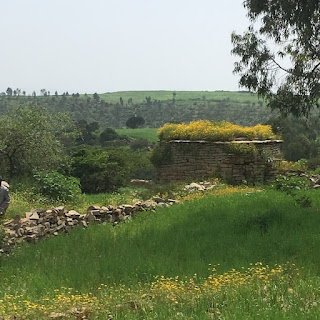
Countryside with Meskel flowers
And so we meet again! This time, I am writing on a Friday morning, but only just.  It's almost two am.  I have been killing mosquitoes, a near nightly ritual that doesn't usually coincide with blogging, but as the internet was unbearably slow last night, I figured I may as well make the most of things.

It occurs to me that I should probably title my postings.  If I were to give a title to this posting, what would it be?  Maybe, "I feel for Cersei Lannister", or "Two Ethiopias", or "On Being a Foreigner in One's Home Land", or "Why Can Nothing Here Be Simple?", or "May God Forgive Me For Being Immature, Impatient, Unforgiving, Petty, Vain, Small-minded, Etc.", or maybe just "The value of the goose-chase."

I thought I'd be writing a different sort of blog once I'd been here in Mekele for a month.  But the truth is that we're still getting settled, if you can believe it.  Something always crops up, or breaks down, or both.

Somehow, in spite of constant shopping trips and appointments, however, we managed to nip out of town last Saturday for a hike to visit a church buried deep in the country-side.  Our intrepid leader in all family excursions, Mark, led us boldly until his guide book disagreed with some local shepherds.  The book literally said to turn right at the fork, the shepherds said to turn left.  We closed the book and followed them.  The church, when we found it, was so nondescript and so different than how it was described in the book, that we almost turned around without going in, disappointed and disheartened.  I'll explain why we were so disheartened in a minute.  But we did go in, and what an incredible treasure awaited us.  Imagine a woman taking off a hum-drum overcoat to reveal a priceless gown.  The simple church, Yohannes Mekmet, contains an inner chapel whose exterior walls are covered from top to bottom with paintings that date back some 200 years.  I wish I could show you all the pictures we took, or give you some sense of the magnificence of these murals hidden within the humble walls of the church.  (I have tried in vain to include pictures here, but the internet continues to defy me.  If you're reading this, you're definitely my friend on facebook, and have seen the pics.)
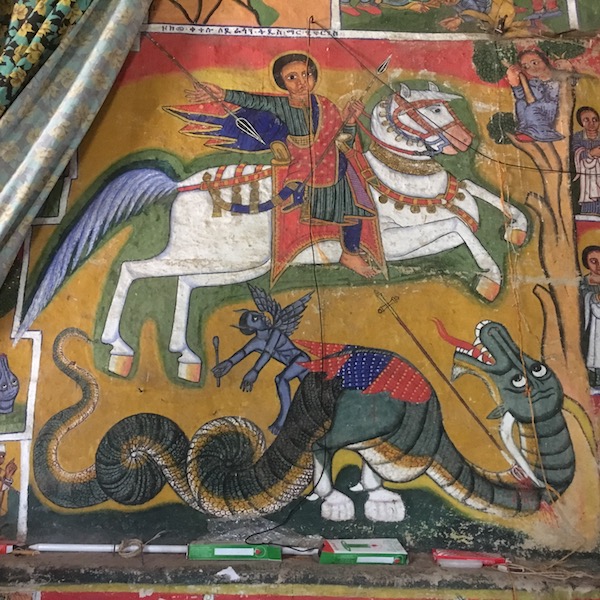
No one was at this church but our family, and the men who perhaps kept the church running accompanied us on our short tour within the circular building.  The head custodian then told us that we could look at very old bibles, which I kind of didn't really believe could be just...there to look at.  But sure enough, we went outside and he laid out a carpet, took off his shoes, and brought out two manuscripts that dated back almost 500 years.  It was a strange and awe-inspiring sight, at the same time - these grand and historic documents laid bare for all to see while goats and donkeys munched grass nearby.  I felt sad, and yet thrilled that these documents were so readily available.  Their pages are so fragile, and should probably be under glass and appropriate lighting.  But here's why I'm thrilled.  These aren't just artifacts for the believers in this and countless other churches across the country.  They are the living, breathing word of God, to be cherished, for sure, but to be used!

I want desperately to remember that little outing for the beauty of the paintings, the timelessness of the landscape, and the resiliency of the church in Ethiopia.  But here is where I struggle with the idea of Two Ethiopias.  On the one hand, the history of this place and specifically its unique position in Africa as a country that has never been colonized, make Ethiopia a must-see destination.  Its culture, language, food, religions, traditions - all have been preserved in a way that's truly authentic and indigenous.  The pride its people display in honoring their traditions is evident.  There's absolutely no self-consciousness about it. In much the same way the ancient Bibles were brought out for us to see - no glass cases, no soft museum lighting - people here bring their traditions with them to daily life, in a way; wearing national dress and engaging in widely celebrated rituals with a level of comfort and joy that I don't see anywhere else.  We just celebrated New Year here, for example.  Everyone was in lockstep; buying sheep and chickens to slaughter, getting hair done, lighting bonfires, declaring it proudly to be 2010!  And that's not just a pretend date.  That is the actual date here, the rest of the world be damned.  So there's much to be admired about this once grand empire and its people.

Alas, here is where I identify with Cersei Lannister (She's the baddie from Game of Thrones, for those of you who are going, "huh?"), and where I feel like Ethiopia is two places.  As I mentioned, I wanted to come away from the outing to the church with a sense of wonder about what we'd seen. But the truth is that when you walk with one white person and three half-white people, especially in the country-side, you are subjected to constant - no exaggeration - constant cries of "Ferenji, ferenji!", or "China, China!"  There's a lot of pointing, a lot of laughing, a lot of muttered comments and chuckles that follow you, hound you, mock you, nearly rob you of the joy of walking in the beautiful countryside in the near perfect September weather.  It is unbelievably unsettling.  Eli revealed that he always wears a cap so that he can pull it low and cover his face while looking down at his feet.  Micah says he wants to punch people.  Daniel has begun to engage in staring contests.  It's hard to describe why it's so depressing to constantly be under such scrutiny, but it's exhausting.  Absolutely exhausting.  I can't tell you how many times I heard people leave their homes and run to neighbors, yelling, "Tsa'ada, tsa'ada!"  (White person, white person!")  Here in this proud country, where history is alive and well, to be regarded as aliens from outer space, never to feel welcomed and embraced - well, sometimes it's just too much.  Occasionally, I feel a tremendous weight of guilt for bringing the boys here with the encouragement that they are to think of this culture as theirs when all they feel while out and about is that they are laughably different.

As we walked through a village called Sarawat on the way to the church, I won't lie; I felt abused by the stares, calls, laughter, pointing, etc, and could see that the boys felt it, too.  On our way back, I knew we would have to walk through that village again, and told the boys, "Listen, maybe you can think of yourselves as pioneers or something, like you're the tough loners in a strange land and you're not scared of anyone.  Maybe you can think of yourselves as Clint Eastwood and whistle that tune from The Good, The Bad, and The Ugly."  I even whistled it for them.  But as we approached the town, I didn't think so much of Clint Eastwood as I did of Cersei Lannister.  Game of Thrones fans will remember the episode a season or two ago when she was forced to walk naked through a gauntlet of Kings Landings residents, hounded by a single word; "Shame, shame, shame".  A bit melodramatic?  Maybe.  It wasn't nearly as bad as that, but let me tell you, I quickly changed my mind about walking through that town again and we boarded a public van that took us the rest of the way home, hidden behind the little curtains that made us blessedly anonymous.

Our white friends tell us that you get used to it, that maybe there's extra scrutiny directed towards us because I'm Habesha and the rest of the crew is not.  Our Ethiopian friends assure us that no harm is meant by it, that people out in the countryside are just provincial, and that Ethiopians are proud, but direct.  All this may be true.  But the abiding lesson I and Mark are trying to give the kids is that you should never, ever, ever make someone feel like a stranger.  When they see immigrants struggling to fit in in their schools and communities, when they see footage of Syrian refugees stranded in camps across increasingly hostile nations in Europe, when they see a kid who's left out and mocked or bullied, we want them to think about what it feels like to be pointed at, to hear snickering behind their backs, to be made to feel different.  And we want them to be compassionate.  Perhaps, with passing time, we will get used to it.  Perhaps in later years they'll see the Ethiopia that stands proud among African nations, preserver of her ways and traditions, unabashedly unique, and not the Ethiopia that still seems so mired in its own Ethiopian-ness that anyone else is an outsider.  Until then, may they remember to be compassionate.

What else has been happening this week?  Here's where I ask the question, "Why can't anything be simple here?" Every time a need crops up requiring our attention, we laugh and ask ourselves, "What kind of wild goose chase will this entail?"  It's often the case that we require something basic, or at least common here;  say, a gas canister.  Or a large clay pan to make injera called a mitad.  It so happens that we were set to pick both of these items up yesterday (cousin Rahel had ordered the mitad for us from a high quality place and had told us it was ready for pick up, and the gas canister guy said we should come yesterday as well), and as we set out from the house, I asked Mark what the likelihood of us accomplishing both of these missions was.  He said, somewhat skeptically, "Zero per cent."  Then he hedged; "Maybe we'll get the gas canister."  He said this because getting the correct canister has proven an ordeal that has taken weeks and four separate trips to the shop and he felt that maybe this time we'd get the right one, especially since the guy told us it would be ready.  Anyway, long story short, we went on this mission, instantly recognized imminent failure, argued in the middle of the market, and came back separately without the mitad or the gas canister.

Ok, sorry, I just have to give you a taste of what imminent failure actually sounds like.  I picked up the phone to let the mitad people know I was coming.  I said something like this;

"I am Marta.  My family member who is called Rahel, called you five days ago.  Maybe four days ago.  I don't know.  She ordered a mitad.  You told her it was ready today.  I am Marta.  I will come and get it.  Where are you?"

Here's the response I received initially, or at least what I heard;

"Huh.  Do you want the wrap, too, or just the dress?"*

After a while, they understood that I wanted a mitad, not a dress, because how can you make injera with a dress?  But their lack of understanding of who Rahel was in relation to me and what kind of mitad I wanted and who the heck I was frustrated them and they hung up on me.  Twice.  Meanwhile, back at home, Azeb (house help) had made the injera batter in anticipation that she could bake injera today with the brand new mitad, and the batter - having fermented for three days already - could go bad.  Mark and I decided to try to get the gas canister while we waited for Rahel to call the mitad people and explain that my ignorance of language should not bar me from receiving the mitad that she had ordered on my behalf.  So we get to the gas place, and the very gentleman who told us to come that day looked at us and asked why we were there.  I told him he'd told us to come.  He said, "Why didn't you call? The delivery truck is on the road, come back tomorrow."

I won't bore you with what happened after that, but suffice it so say when the gas guy looked at me tenderly and asked "Aren't you tired of coming here?" (The gas canister mix-up has always been our fault, actually, not his).  I actually turned away from him so I wouldn't cry.

So I came home, as did Mark, with nothing to show for our hours downtown but a headache from the shame of not knowing the language well enough to just get the most basic things down, or the understanding of how things work here (when I told cousin Rahel about the gas canister, she asked "Why didn't you call first?"  Because he said come back Thursday, dagnabbit, so that's what we did!).  But here's the thing; I came home to find cheerful boys who had gone out to buy injera for dinner, and who had a wonderful conversation with a total stranger at the kiosk.  Micah, the most sensitive of the boys, said that yeah, there were some boys who laughed and pointed and commented (perhaps the same boys that jumped he and his brothers in the first week and stole some pastries right out of their hands as they walked home one day), but that he ignored them, and kind of enjoyed the outing.  I came home to that, and to a dinner that was prepared by Azeb, ready and hot on the stove.  Everything that you could want to put on injera - a full day's labor not done by me.  I came home to electricity, and water, and warmth.  I came home to my favorite soap opera, an episode of which I missed last night, by the way, because we had gone out to dinner with friends.  So now Hazal has been in a car accident and is trapped under a car while her mother Gursulan strokes her hair and screams for help.  How did this happen?  Why were they in the car together when everyone knows they haven't been speaking for months?

But I digress.  See?  God has been merciful if that's what I'm thinking about right now.  In spite of my frustrations and failures, here we are.  What an amazing thing to be thousands of miles away from home, from our jobs and incomes, and still be able to sit here and worry about a mitad, or the right gas canister.  As if all around us the toughest people in the world aren't surviving with infinitely less.  Yes, I've been up at least three times to kill mosquitoes since I started writing, but I'm warm, well-fed, and have almost a year ahead of me to grow into this place.  A year to hold my head high and teach my boys to do the same.  A year to grow into the language and not clench my fists in frustration at being so inept.  A year to get the gas canister issue down pat.

A year to appreciate what you find along the roadside when you're on a wild goose chase.

*I have since learned that the word I heard - "netela" (which is an Amharic word meaning a wrap for an Ethiopian dress) - was actually the Tigrinya word "netsila", which means one.  As in, "Do you want one mitad?"  We did successfully pick up the mitad today, and Azeb translated that word for me, amidst much laughter.  Oh, and we got the gas canister, too.

p.s.  Why the cries of "China, China"?  The Chinese have a huge presence in Ethiopia, and are involved in numerous infrastructure and construction projects.


Thursday, September 7, 2017

Teddy, Azeb, and Turkish Soaps

Okay, my friends - all two of you.  End of week three.  Here we are.  Mekele, Ethiopia.  Still.  Ha!  They haven't gotten rid of us yet!

In all seriousness, week three finds us remarkably well.  That is to say, we have no illnesses, have made more friends, hired some house help, and done the unthinkable - we got a dog!

Teddy enjoys a bone
As I told Mark when he realized the dog would be dropped off at our house within the half hour, "This is the year of living dangerously."  Now for some, living without a dog is living dangerously.  Not so for us.  The prospect of picking up dog poop, worrying about fleas and illnesses, and general bad canine behavior is something that made getting a dog a non-starter in the US.  But here in Mekele, the dog - who speaks Tigrinya and whose name is Teddy - lives outside.  No amount of puppy whining and cuteness will allow those big ol' paws to cross the threshold.  Although one day the little rascal did manage to sneak in the back door and lick my hand while I was watching a soap opera.  I ushered him out, lickety split.  Bless him.  He doesn't speak Amharic; the soap would have bored him stiff.  Back to the soap opera in a bit.  But yes, we named our dog after Teddy Afro, whose music serenaded us on our ride from Addis to Mekele.  He's a cute 8 month old German Shepherd.  And he's staying outside!

A distant relative who we "discovered" last year has also stepped boldly into our lives and has dedicated hours of her time off from work to show us how to be true Habeshas.  Her name is Rahel, and she was flabbergasted at my lack of a coffee set for the house.  We bought one, and it is sitting in my living room taunting me.  I, a coffee novice, will soon become that Habesha lady you see roasting, grinding, brewing coffee and carefully pouring it into tiny cups.  As we say in Amharic, wey ney.  My goodness.  Who would have thunk it?  This is a picture of Rahel selecting from various grades of coffee at the market.
Rahel inspects coffee
Before I move on from Rahel, it has to be mentioned that she managed to take Mark and I down to a part of town we'd never been to before.  In that part of town, it is possible to buy pretty much anything from a roadside stand.  We bought a bed and a mattress and she oversaw it being loaded onto the tiny three-wheeled bajaj that took us home.  I'm telling you, no vehicle has more of my respect than these little blue guys that put-put up and down this city with ridiculous loads on their roofs.

Why did we need a bed?  We needed one for Azeb, the young lady who we have hired to help us around the house.  Azeb was brought to us by a friend from church and let me tell you, she may be inexperienced and brand new to Mekele, but she is so hard-working and diligent that she makes me wonder how on earth I have survived without her all these years.  My only concern is that she has not been able to eat the bland, ferenji food I prepare.  Luckily, Rahel - our relative - had an answer to this problem, an answer that I think she believes will provide the solution to all of our problems; make only Ethiopian food in the house.  It's easy to be persuaded by an argument like that, especially if I'm not the one who has to cook it all the time.  So Azeb, Mark, and I went downtown today for the umpteenth time, this time to find tef - the grain that is used to make injera.  Azeb found some that she approved of, and it is being ground to powder at the mill tonight.  We'll pick it up tomorrow.  I, a mere injera eater, will soon be that Habesha lady pouring injera batter over a hot pan, making every blessed item of food from scratch as they do in true Habesha homes.  Wey ney.  Who, but who would have thunk it?  Wait, who am I kidding?  When we get home to Maryland I'll go back to buying my injera at the 7-11.
Azeb inspecting tef

Azeb and Rahel, indeed any Tigrayan that we meet has been charged with the solemn duty of speaking to us in Tigrinya.  Mark has been sustaining the effort to learn the language admirably.  Today, when some boys threw stones in his direction as he took a short jog, he was able to tell them in terse Tigrinya, "Cut it out."  Then he rehearsed what he would have said to their parents with our Tigrinya teacher; "These young boys threw stones at me."  But he has a forgiving attitude about many such offenses, I must say, and will probably have forgotten about it on his next run.  Me?  I refuse to run here.

As for Tigrinya, I have finally joined Mark and the boys at the table during their daily Tigrinya lessons as I have come up against - within a scant week - the outer limits of my Tigrinya and am in desperate need of proper conjugation of verbs.  Yonas, our teacher, is really very good and very patient.  It's always fun to hear him give commands in Tigrinya that must be obeyed; "Markos, ab terepeza la'li heres!"  ("Mark, sleep on the table!").

I take much more pleasure in my Amharic lessons, though.  These come by way of the soap operas which I promised I would return to way back when I was introducing you to Teddy.  I am permitted to change the channel from CNN for one hour a day during which time I sit very close to the TV and watch Turkish and South Korean soaps while shushing everyone.  These soaps are dubbed in Amharic and are wildly entertaining.  I've got my eye on an Italian one, too, but the people in that soap are really over the top good-looking, and I don't trust them.  I can't vouch for the Amharic I'm learning.  I can say things like, "Mehmet, I know your daughter Irsan has double-kidney failure. I can find someone who will donate a kidney for the transplant, but you must sign over all your wealth to me, first."  Or, "Jae Hun is not just a family friend, she's...your sister!"

These sorts of phrases might come in handy some day, you never know.  Meanwhile, we struggle on with language, resting assured that at least Teddy understands us.  "Kof!", we say, and he sits.  Sometimes.  He's just a beginner.  We're all beginners, really, in this house; us, Teddy, Azeb.  

Now doesn't that sound like the makings of a good soap opera?

Thursday, August 31, 2017

Community

Well hello!

I have been compiling a list of things I thought I might write about in this post.  Some of the possible topics of discussion included the cake I baked on the stove top using Ethiopian spiced butter and bananas (I commented to my brothers that it taste like tibs - fried meat - married banana bread), the mud of Mekele, homeschooling, top five restaurants of the week (yes, we eat out a lot), and language lessons.  All of those topics will have to wait, because the overwhelming theme of the week has been "community".  Here I will post a picture of a few friends we have made in Mekele and then tell you a little story.  This picture was taken at a Sunday afternoon worship service in the home of Greg and Elizabeth (EJ) Spencer, who are leaning up against the counter.  Heading towards the table is Sarah, an aid worker at the Mekele Youth Center.  On the right is Charlotte, and standing near Greg is Karen. Karen and Charlotte have both worked with healthcare in Tigray.
So, the story (it's short, I promise):  Last year at Blair High School, I was called down to the main office because a young fourteen year old girl freshly arrived from Ethiopia could not speak English and had a few questions about how she was supposed to eat lunch.  I went downstairs and discovered, using my very rudimentary Amharic, that the girl's father was maybe doing some paperwork to maybe get her set up so that she could maybe participate in the free and reduced meals plan.  Until that paper work had been sorted, she was told, she could not eat lunch at Blair.  She asked how long it would take for the paperwork to go through, and we told her it would take about a week.  "Just have your folks pack you a bit of lunch!" I suggested gently while I walked her to the cafeteria to wrangle some food out of the manager.  She kept a very straight face and nodded. I left her in the hands of students from the Ethiopian community at Blair and moved on with my day.

I tell that story because I feel we have been in that girl's shoes for two weeks, now.  And if it hadn't been for our stint in Mekele - a place where we knew virtually no one and understood basically nothing about how things worked - I wouldn't be forced to recall with shame my casual suggestion that the girl just pack a lunch and bring it with her.  To begin with, where would she get the food?  Someone who's used to eating injera most meals may not even know what a packed lunch in the US looks like.  What do you pack it in?  What kind of materials do you need?  How much do they cost?  Do you stuff it in a plastic bag?  If so, what kind?  Ziploc?  Large, small?  Paper bag?  Where do you get those?  Lunchbox?  What is that and where do you get it?  The nearest Target can't be reached on foot, and if you're in Takoma Park somewhere, maybe you have no idea where the nearest Giant is, or what Giant even is.  The simplest thing for a homegrown American kid in America becomes an enormous hurdle for the foreign kid.

We are the foreign kid in Mekele.  And it really, really, really sucks sometimes.  I can tell you that every single person in this family has shed tears during the course of the last couple of weeks because each waking moment has been spent so completely outside of our comfort zone. Nothing seems straightforward.  Shopping is an experience that frazzles the brain and exhausts you.  There is no Target.  So consider this; imagine you want to buy clothespins (because you have no washer/drier in the house).  You have to find the mode of public transport that will take you to the right part of town.  Then you have to find the right type of shop.  Then you go to three or four of these shops and ask with your broken Amharic and nonexistent Tigrinya if the shop sells "those things that you put on wet clothes to put them in the sun outside", or "those things that do this (squeeze your fingers together) to your clothes after washing", or some other awful translation of something that makes people lean forward and furrow their brows at your ludicrous language.  And then they all say "No, we don't have that."  So you go home with a flyswatter instead and consider that a small victory.

Being the foreign kid is HARD.  I have such a deep, profound, tear-inducing respect for those students who come into my high school in the States without a word of English, lunch money, or friends.  Look at them by the end of the year and they've found their people, they're eating lunch and listening to Drake and speaking more and more English.  The ones that make the most progress are the ones that found their own communities.

The people in the picture above have become, in a very short period of time, our community.  They have given us Chinese food, oatmeal cookies that don't taste like spiced butter, strawberries (!), and more.  Sarah spent an entire day taking me around town, showing me the post office and how to get a post office box, where to find red meat and have it ground for you, and - glory of glories - where to find cheese.  She didn't even get mad at me for breaking her toilet flusher.  Greg and Elizabeth are hosting our boys for tacos and a movie night at their house as I type.  They sent someone to our house  earlier today to help us replace our gas canister so we can use our stove more efficiently.  Okay, it was a typical Mekele ordeal (wrong canister bought, had to be returned, etc. - who knew not all cooking gas canisters were not standard in a city this size?).  To sit with these folks last Sunday, listening to a Tim Keller podcast and singing familiar songs was to be reminded of the good things that make a home a home.

Listen, we're so happy to be here, so lucky and so incredibly thrilled for this opportunity.  I just had to share how disorienting and exhausting it can be to be the new kid, and how warm and sheltered it feels to be in the care of a community.

That said, let me tell you of the gentle landing Mekele has given this new kid. First, no one laughs when I speak.  God bless them, because I know I say some very stupid things.  Second, if you go into a shop during lunch and ask for something, you will find the shop owners gathered around a plate, eating injera, and they will often invite you to join them.  Third, today, when I was searching for the right canister, the bajaj driver who was going to give us a ride home, came into the shop and huddled with a group of us to help sort things out.  When I didn't have enough money, he pulled a wad of cash out of his pocket and handed it to me.  Don't worry, I paid him back, but where else can you imagine a cab driver doing that?

So, Mekele will be our wider community someday soon.  Until then, we'll let these kind folks who once were the new kids ease our way into life here.  The progress is real.  After two weeks of eating the most delicious Ethiopian food you'll ever taste in your life (that's a promise), Mark and I were ready for a good old-fashioned burger tonight.  It had an egg and the traditional karya (chili pepper) in it, but it was fine by us!

Thursday, August 24, 2017

Mekele, here we are!

My goodness, it's tough to make a simple blog post here in Mekele, Ethiopia. I won't bore you with the details, maybe Mark will set up a tech corner on this blog and tell you all about Ethio telecom, wireless routers (or lack thereof), and hotspots. Even now, as I type, I'm mourning all the amazing pictures our network didn't have the patience to post.  Be my friend on facebook if you want to see them.

But here is one that did upload. And a fitting picture it is; the happy five en route to Ethiopia. Of course, since that picture was taken, we've smiled some and cried some.


 Yes it's true, even people as lucky as we are, with every resource and all the good wishes of the world at our backs, can shed a few tears.

To start with, Addis Abeba doesn't provide the most gentle intro to Africa for boys who've been raised in suburban Maryland.  This quote from Daniel, who is unfailingly polite about everything, sums their initial reaction up: "Mom, no offense, but I'm not sure about this city."  The sheer volume of traffic, and the brazen disregard for pedestrian rights shocked the guys.  Me?  I slipped back into the Kenya mode of street-crossing; a combo of strategic dashing and playing chicken with taxis.

Our hotel in Addis, while lovely, had no hot water.  In this rainy, muddy, and cold season, that was tough.  On the flip side, it was a great introduction to Mekele, where water shortages are a constant feature of life, even during the rainy season.  I tell you, no family has been better able to cope with short (or no) showers upon entry to this wonderful city.  Let's go back to the flipside again, though; we might be pretty funky.

What can we say about Mekele other than that it has presented us with some predictable but also some unpredictable experiences.  We knew we would be met with people who would care for us and help us settle in.  We knew we would eat well.  We knew we would have water and electricity challenges.  We did not know how helplessly we would depend on people here because we do not know the language well, or how things work.  We did not know that we would be eating out most days because we didn't know where to get groceries, or how to make food safe for eating and milk safe for drinking.  We didn't expect that our biggest water problem - even as water is short - would be flooding.  In fact, my first and most urgent purchase was towels. Towels for the floor.

But perhaps the sweetest treat has been that our arrival in Mekele coincided with the annual festival of Ashenda.  I wish I could post more pictures here of this incredible few days where the whole town is dressed up and ready to celebrate.  While the main idea behind the festival is to end a fast dedicated to the Virgin Mary, the young girls of Mekele commemorate the occasion with singing and dancing.  Give them a little money, and the delirious group of girls will run to the next shop, car, or cafe.  Or you could just point to Mark and they'll swarm to him.  Mark has been serenaded by countless groups of girls, all smiling hopefully up at him, knowing full well that white dudes always pay up.  It's been cute to see, although as the days progressed, the girls became more brazen and would run to him and say simply, "Money".  Sing, girls, sing, he would say with his international language of hand movements and earnest smiles.  So these last few days have proceeded to the soundtrack of youthful singing and drumbeats.

Let me end with a few stream of conscious observations:

I am happy that within the first few days of being here I was able to look Mark in the eye and ban him - for the remainder of the year - from using the words "to-do list" and "agenda for the day".

I told people before we left that I was excited to be bored again.  Boredom is....well, boredom.  It doesn't feel great, and I realize why we fill our time up so much in the States.  But the hope is that something beautiful fills that space; like the conversations I've had with Micah about the books he loves and wishes he downloaded, or the card games I've learned to play, or just listening to the conversations the boys have; they're so silly but they take me to my youth with my brothers.

I am impressed with the guys and their diligence with their school work.  I'm very hands off, and they tend to dive in and immerse themselves for hours.  On the other hand, could it be an escape from a world outside our ornate gate where other children play soccer on the street with battered soccer balls?  Or from the hordes of girls who sing and dance for a little spare change?  Or from the countless eyes that stare and stare and the little voices that shout "Ferenji, ferenji!" (white person, white person!).  Mark says we should give them time.  And he's right.

Meanwhile, we will continue to figure our lovely, quirky house out, ration our use of water (pretty useful exercise, I must say), learn to ignore power outages, and generally count ourselves lucky for the incredible circumstances that have placed us where we are.  We only have to look around to understand that we are among a tiny minority of people who live as we do in this city.  And soon we hope to begin our volunteer work at Operation Rescue Childcare Centers, which will hopefully continue to remind us of what a lucky lot we are.

That's it from me for today.  I know it was a disjointed posting, but I felt I had to give the old blog a test drive, if only to record initial impressions and feelings that will fade and change as the year carries us along with it.

As always, pray for us, and think of us fondly until we meet again!

Friday, March 25, 2016

At the Cherry Blossoms

Tidal Basin and Jefferson Memorial
Jefferson Memorial
Washington
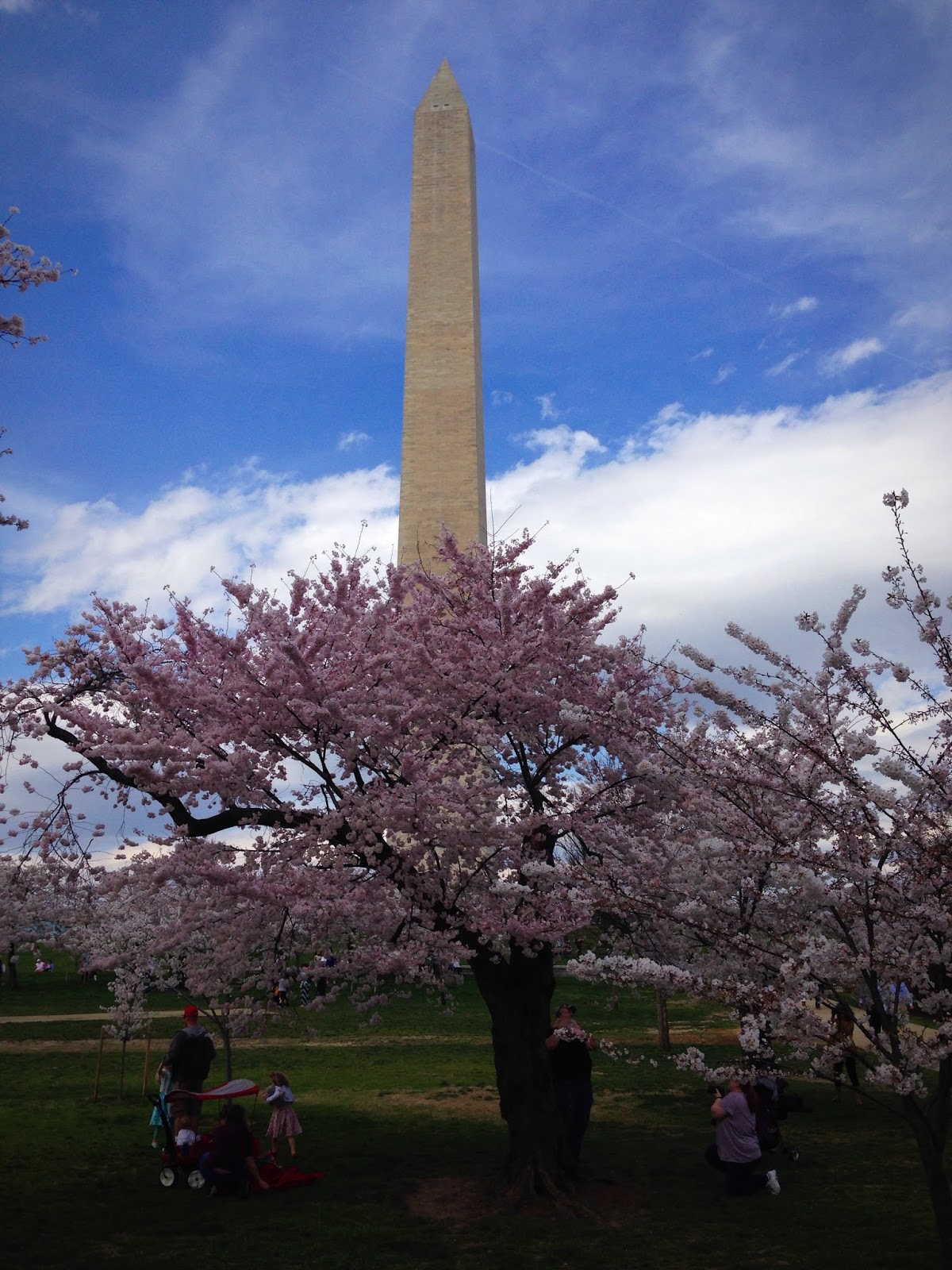
Monument
Cherry Blossoms line the basin
The cherry blossoms in downtown D.C. have reached their peak bloom, weeks before they did last year. We took the Metro down and met my dad for a lunch at Potbelly, and then walked around the tourist-filled tidal basin. The Cherry Blossom Festival had just started, and will continue into mid-April, though the trees will turn green in about a week or two. It was cloudy at first, but when we passed the Jefferson Memorial, the sun came out. It made for a beautiful spring day (70s). It was less crowded for a while near the FDR Memorial, allowing us to truly enjoy the trees and watch the boaters on the basin. Last year, we went on a cold, ugly, and rainy day. We are thankful that we had good weather today! 
A branch up close
MLK Memorial